Cheryl Miller
Former New Atlantis blogger Cheryl Miller is a writer living in Washington, D.C. A 2007 Phillips Foundation Journalism Fellow, she is also the editor of Doublethink magazine. She can be reached at cmiller [at] thenewatlantis [dot] com.
READ MORE
Cheryl Miller’s Latest New Atlantis Articles
“Donated Generation” (Summer 2008)
“Blogging Infertility” (Winter 2008)
“The Painless Peace of Twilight Sleep” (Fall 2007)
Organizations
- American Fertility Association
- American Society for Bioethics and Humanities
- American Society for Reproductive Medicine
- American Surrogacy Center
- APART
- Center for Bioethics and Culture
- Center for Bioethics and Human Dignity
- Center for Genetics and Society
- Center for Marriage and Families
- Donor Sibling Registry
- Ethics and Public Policy Center
- Hands Off Our Ovaries
- Hastings Center
- Institute for American Values
- RESOLVE
- Society for Assisted Reproductive Technology
- Society for Reproductive Endocrinology and Infertility
Fertility Blogs
- Stirrup Queens and Sperm Palace Jesters’s Fertility Blogroll
- Conception Connections
- Cyclesista
- Fertility Stories
- Inconceivable Journey
- The Infertile Informer
- International Infertility Film Festival
- Surrogacy 101
- Surrogacy Issues Blog
- Surrogacy Lawyer
Magazines and Journals
- The New Atlantis
- American Journal of Bioethics
- BioEdge
- Conceive magazine
- Fertility Today
- Hastings Center Report
- Reproductive BioMedicine Online
Bioethics and News Resources
- Bioethics.com
- Bioethics Discussion Blog
- Biopolitical Times (Center for Genetics and Society)
- Blog.Bioethics.net (American Journal of Bioethics blog)
- Booster Shots (Los Angeles Times)
- CORE
- E-Patients.net
- FuturePundit (Randall Parker)
- The Human Future (Jennifer Lahl)
- Human Nature (William Saletan, Slate)
- Our Bodies, Our Blog
- Practical Ethics
- Questioning Technology
- The Stem Cell
- Secondhand Smoke (Wesley J. Smith)
- Triage (Chicago Tribune)
- Varoblog
- Well (Tara Parker-Pope, NYT)
- Women’s Bioethics Blog
Family Law Blogs
Infertility Bloggers
Cheryl Miller discusses her new article about infertility patients who have turned to blogs for medical advice and emotional support.
Saturday, February 14, 2009
‘Closing Conceptions’
Editor’s Note: “Conceptions,” Cheryl Miller’s New Atlantis blog on assisted reproductive technologies, has been discontinued. She is working on several other projects, but will occasionally write magazine essays and articles on ART—such as the article she has in the February 2009 issue of Reason: “Who’s Your Daddy?”
Thank you to everyone who read “Conceptions,” and to everyone who participated in interviews with Ms. Miller.
posted by Cheryl Miller | 11:31 pm
Friday, October 10, 2008
ART in the News
A new test for Down syndrome, frozen embryo laws, and more
- Is it wrong to want a deaf baby?
- Oregon court sees frozen embryos as property rights issue.
- The hidden health risks for the children of sperm donors.
- India: It’s time we had a law on surrogacy.
- How test tube babies changed the world.
- A new, safer test for Down syndrome.
- “Human evolution is only at the beginning!”
- Incest fears down under?
- Families in the making.
posted by Cheryl Miller | 9:08 am
File As: Assisted Reproductive Technologies, In Vitro Fertilization, Eugenics, Contemporary, Surrogacy, Frozen Embryos, Reproductive Law, Sperm Donation, Third-Party Reproduction
Monday, October 6, 2008
The Embryo Dilemma
Los Angeles Times health reporter Shari Roan has a terrific series on “the politics of embryos.” (Bonus: One piece quotes The New Atlantis’s own Yuval Levin.)
ALSO IN THE LAT: How easy is it to donate embryos to research? Or for adoption? Embryo legislation, state by state.Six years of frustration and heartbreak. That’s how Gina Rathan recalls her attempts to become pregnant.
Finally, she and her husband, Cheddi, conceived a daughter, now 3, through in vitro fertilization. About a year later, she became pregnant with a second child, naturally. Their family was complete.Then, a year ago, the Fountain Valley couple received a bill reminding them that their infertility journey wasn’t quite over. They owed $750 to preserve three frozen embryos they’d created but hadn’t used....
Finally, the couple paid for three more years of cryopreservation.
“I think about the embryos every day,” Rathan says. “I am their mother. I see them as my own children. They are the DNA from my husband and I. It’s something I worry about, especially when the three years is over and I have to make a decision again.”
posted by Cheryl Miller | 9:27 am
File As: Bioethics and Medicine, Stem Cell Research, Assisted Reproductive Technologies, Embryo, Moral Status of the, Embryo Adoption, Frozen Embryos
Friday, October 3, 2008
ART in the News
Cheap IVF, medical tourism, and more
- “Women: Have your babies yesterday.”
- Looking for cheap IVF? 13 questions and answers about medical tourism. And just how expensive is IVF anyway?
- Biologists describe how an embryo attaches to the womb.
- The Bronx is the place to be for gay families.
- Feminism or folly? Women who conceive accidentally on purpose.
- Mothers may not tell after donor egg, sperm birth.
- Having a half-sibling on the other side of Europe.
- Men without children.
posted by Cheryl Miller | 1:37 pm
File As: Assisted Reproductive Technologies, In Vitro Fertilization, Egg Donation, GLBT Parents, Single Mothers by Choice, Sperm Donation, Third-Party Reproduction
Thursday, October 2, 2008
Questions for Damian Adams, Donor-Conceived Adult
Part Two: The anonymity debate, children’s rights
Part Two of my interview with Damian Adams. See Part One here.
Have you been involved with any campaigns to fight for the rights of DC people?
DA: I have been constantly writing to state and federal politicians. I have been in contact with the state regulatory authority. I have met with the federal attorney general. I have had articles published in the media highlighting the cause and also appeared on a few television shows. I have presented a talk at the national DCSG conference and talked at a seminar attended by clinicians and persons involved in the fertility industry in South Australia.
What do you hope for from a meeting with your donor? What would be your best-case scenario? The worst?
DA: Anything, everything, and nothing. That probably doesn’t make much sense, but I would be willing to accept anything, just so long as I know the truth about who I am and my heritage.
Best-case scenario would be a relationship of sorts—not necessarily a father-type relationship. (I am a realist.) A medical history should be mandatory.
Worst-case: What I am currently in. I am in limbo with no way forward.
What do you think of open-donor programs (i.e., where the donor is identified to the offspring when they come of age)? Do you think they are a workable compromise? Is it simply enough for a person to have the chance to meet and know their biological parent?
DA: This is where a lot of people have trouble understanding my argument. I am not saying that non-biological parents can’t make good parents. There are good and bad biologicals and non-biologicals. The thing is people need to take off their “glasses” and look through a child’s eyes and not through those of an adult.
Being raised by both biologicals is preferable, because it is who we are, our flesh and blood. We see ourselves in our parents and them in us. It is the continuance of kinship and heritage. This is the best-case scenario and to deliberately do otherwise is to deprive the child.
There is no way to ensure that those conceived in DC families will ever know of their origins. (A recent study in Australia showed only 33 percent intended to tell—even less do.) So immediately there is a problem with the majority of families deceiving their child. Deception is not a foundation to build a family on—truth is.
Then there is the issue of kinship separation, loss of identity, heritage—these cannot necessarily be fully retrieved in an open-donor situation as the constant contact and interaction is not there. It is well known in adoption circles that these things are harmful to a child yet we are unable to acknowledge them in the DC community. It is a double standard.
What misconceptions do people have about donor-conceived people?
DA: Some people have argued against views such as mine saying that [such views] are from children raised in a dysfunctional family. However, I was raised in a very loving home, and I love my social father and respect him very much.
They then also try and dismiss my views as being from a disgruntled and ungrateful minority, yet they fail to understand that at one point in my life, I was very grateful and even proud of being DC. But after the epiphany I experienced [when] my daughter was born and realizing that we cannot arbitrarily choose which genetic connection is to be important to children, I had to completely reverse my stance.
posted by Cheryl Miller | 8:49 am
File As: Sperm Donation, Third-Party Reproduction, Conceptions Interviews
Thursday, October 2, 2008
Questions for Damian Adams, Donor-Conceived Adult
Part One: Blogging the search for your father
Damian Adams was conceived through donor insemination in 1973 at the Queen Elizabeth Hospital in Adelaide, South Australia. He has been searching for his biological father for over five years, and keeps a blog, Donated Generation, on donor conception ethics and practices.
An advocate for the rights of DC offspring, he has worked with the Donor Conception Support Group of Australia and TangledWebs. He has made numerous media appearances to discuss the unique challenges faced by other “half-adopted” people. You can learn more about his search here.
In this interview, we discuss his search for his biological father, children’s rights, and the donor anonymity debate.
For more on donor-conceived offspring, see my latest article in The New Atlantis.
[Interview edited, condensed, and hyperlinked by Cheryl Miller. Part Two to follow.]
When did you start your blog? Do your friends and family know about the blog? How have people reacted?
DA: I started the blog in July 2006. My wife knows about it as do some of my DC community friends on the Web. No one else does. To be honest, I haven’t had much reaction about it apart from my DC friends who appreciate and agree with what I have written.
When and how did you find out that you are donor-conceived?
DA: From the very beginning. I would have been about three or so.
I imagine if I had found out later in life that I would have taken it very badly and harbored bad feelings towards my parents for deceiving me. Many people use the argument of early disclosure to say that if it occurs then the person would be happy with being DC. I guess I am evidence to the contrary.
You say on your blog that it wasn’t until you were 28 and had children of your own that you began to question your origins. What changed for you?
DA: While I started off searching for non-identifying information (as I at one time agreed with anonymity), I have now changed my perspective, and I wish to know who this person is. This view changed after the birth of my daughter. It was a moment not too dissimilar to the moment that parents often report experiencing when they hold their child for the first time and stare into their baby’s eyes. It was an acceptance and knowledge of a biological connection. That no matter what might happen in the world, we would always be father and daughter. No one or no thing would ever be able to change this.
This biological connection made me think about how I would feel if my daughter grew up not knowing who I was. I need to complete the picture of who I am not only for myself but also for my children. My search is just as much for them as it is for me. The implications of being donor-conceived do not end with me but continue on into the following generations.
How long have you been searching for your donor?
DA: The initial search for non-identifying information started when I was 16. My family is aware of my search and is fully supportive. My mother even assisted in the early stages, and obtained her treatment records for me. Searches for identifying information started in earnest when my daughter was born.
What have you done in searching for your father/siblings? Are you on any donor/sibling registries?
DA: I have been in contact with the hospital and the clinic that obtained the records when the hospital stopped conducting fertility treatment. I have also spoken to the clinicians involved at the time. Through some strange coincidence, my wife’s obstetrician, who delivered our children, was one of the registrars who conducted the procedure (although I was not aware of this when he first became her obs). These clinicians have tried to help in locating records. I have searched through university records of medical students. I have appeared in print, televised, and spoken (radio) media.
I have also joined/registered on a couple of online registries. While there has been a South Aussie donor who has since listed on one of those registries, he is not from my era. There are no other South Australian offspring on them as yet. I decided to finally put my name on them to cross all the boxes and leave no stoned unturned.
I believe that I know who my father is. However, he has denied it. This has been extremely traumatic, and I cannot obtain closure. I cannot get a definitive answer either way.
Have you met any potential half-siblings? If you haven’t, would you want to meet any?
DA: I have not met any potential half siblings. But I would like to. To me the issue of half-siblings, whether through other donations or from a normalized relationship with my father, is of equal importance as finding my father.
posted by Cheryl Miller | 8:33 am
File As: Sperm Donation, Third-Party Reproduction, Conceptions Interviews
Monday, September 29, 2008
Symposium: Getting It Right — Putting Ethics at the Core of Gamete Donation Practice
If you're in the Toronto area, I will be speaking about my latest New Atlantis article, "Donated Generation," at a symposium hosted by the Infertility Network. The event is this Saturday, October 4, 2008, at the Michener Institute. (Map and directions here.)
There will be some great speakers: Olivia Montuschi, co-founder of the Donor Conception Network; Kathleen LaBounty and Karen Clark, two donor-conceived adults; and Eric Schwartzman, a DI-dad.
A brief description of the seminar:
Symposium: Getting It Right – Putting Ethics At The Core Of Gamete Donation Practice
Saturday, October 4, 2008. 9:00am - 5:00pm. Open to all.
Michener Institute, 222 Saint Patrick St., Toronto (near University Ave. & Dundas St.)Explore the complex ethical issues of egg and sperm donation from the perspectives of adult offspring, recipients and donors, as well as the LGBT and adoption communities, with input from support group leaders, researchers, ethicists, counsellors and medical professionals. The discussion will focus on the importance of education and support, along with the need for accurate, complete, accessible records, protected against loss or destruction. It will also highlight shortcomings in the current system and the need for more accountability.
Discover the similarities and differences among systems in countries that enable a donor-conceived person to learn their donor’s identity and the challenges posed by the abolition of anonymity. Listen to personal stories from offspring who want to learn more about their genetic kin. Learn how similar past practices in adoption (e.g. secrecy and sealed records) are giving way to openness and information sharing.
Hear up-to-date research on the long term medical and emotional ramifications of egg donation; the expected changes in the United Kingdom following implementation of the new legislation (e.g. provisions for offspring to access information about their half-siblings and donors about their offspring).
To learn more about the conference and to register, see the Infertility Network's website.
posted by Cheryl Miller | 7:11 pm
File As: Assisted Reproductive Technologies, Surrogacy, Egg Donation, Reproductive Law, Sperm Donation, Third-Party Reproduction
Monday, September 29, 2008
“One way or another someone makes money off the dead.”
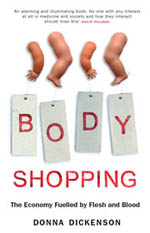
Your humble blogger has a review in the latest issue of the Weekly Standard about Donna Dickenson’s chilling exposé, Body Shopping: The Economy Fuelled by Flesh and Blood. In the piece, I discuss some of the more grisly practices of the global trade in human flesh and how we can rein in the worst of the body-snatchers:
Body Shopping describes a science that has become positively vampiric in its insatiable appetite for human tissue and organs, sometimes outright stealing the raw material it needs. A veritable black market in human flesh has been established, with each part individually appraised and priced: “Hand, $350-$850, Brain, $500-$600, Eviscerated torso, $1,100-$1,290.” A whole cadaver can fetch up to $20,000. The uses to which this tissue is put are no less gruesome. Bone dust from stolen cadavers might be found in your dental work. The collagen used to plump a starlet’s lips is likely derived from the cells of an infant’s foreskin. The “secret ingredient” in the various beauty treatments marketed to Russian women? Aborted fetuses from Ukraine.
“One way or another someone makes money off the dead,” one proud body snatcher declared, even as he pleaded guilty to over 60 counts of mutilation of human remains, and embezzlement. The entrepreneurial spirit cannot be tamed, it would seem, especially in so lucrative a venture as body shopping.
RELATED: I interviewed Professor Dickenson about her book for Conceptions here.
posted by Cheryl Miller | 9:55 am
File As: Bioethics and Medicine, Stem Cell Research, Assisted Reproductive Technologies, Cloning, Egg Donation
Friday, September 26, 2008
ART in the News
Clay Aiken: Gay Dad, Teen Pregnancy Barbie, and More
- Pregnancy on the rise, abortion rates lowest in 30 years.
- How to stay sane with multiples.
- Designing the $100,000 baby.
- Remote control male birth control.
- Clay Aiken has a gayby.
- Israeli women are coming to the U.S. to donate eggs.
- "I've become more conservative since carrying a baby to term, but not so conservative as to assume that a ball of cells is a person."
- Teen pregnancy Barbie.
- India's global surrogacy business: "Come as Couple ... Leave as Family."
posted by Cheryl Miller | 8:12 am
File As: Assisted Reproductive Technologies, In Vitro Fertilization, Surrogacy, ART in popular culture, Egg Donation, Frozen Embryos, GLBT Parents, Reproductive Law, Third-Party Reproduction
Thursday, September 25, 2008
“Pay for semen? Really??”
Amy, a female blogger, is advertisting for a sperm donor via her blog. She claims to have 15 candidates. I’m guessing this must be a hoax since it is an incredibly bad idea otherwise (especially from someone who claims to be attending law school). Here’s her pitch:
In less than two weeks, I will be ovulating, which as everyone should know is primetime for baby making. The problem is that I don’t yet have a partner for this process. Now, I’m not looking for a source of child support or a baby-daddy in the sense that he should have any supportive role in the pregnancy or in raising the child, I just need some good, hearty seed....
Since I have successfully dated two people through this blog network I am turning to it again for assistance in this effort. The network has agreed to help financially with the baby but I am turning to the readers/commenters for my donator. The nail in the coffin was the latest example of using the Internet as an efficient means for a solution—whether it’s paying college tuition or finding the right donor.
posted by Cheryl Miller | 2:58 pm
File As: Assisted Reproductive Technologies, Sperm Donation
Wednesday, September 24, 2008
“Sex is for recreation; leave reproduction to the professionals.”
In Intelligent Life magazine, Helen Joyce discusses “social egg-banking” and the IVF revolution to come:
I believe the true IVF revolution is still to come. Soon, IVF may be better than natural conception for many, perhaps most, couples, not just those who can't make babies the usual way and the fewer still who know they carry genetic diseases.
The first steps to this reproductive nirvana are already being taken by a few brave, or foolhardy, souls. They are freezing (or, strictly speaking, “vitrifying”) their eggs in order to keep them fresh till the right man comes along. Men have been able to freeze and bank their sperm for decades, for example when facing cancer treatment that risks leaving them infertile, and couples can store surplus embryos produced during IVF. But eggs are a tougher challenge. Sperm are small, and of the tens of millions in a single ejaculation plenty will survive freezing and thawing; a couple of days after fertilisation, an embryo will consist of several cells, and even if a few don't survive the trauma, the embryo itself often will. Eggs, though, are single cells—so they have no built-in redundancy—and big (many times larger than the average human cell), so they are full of water that can form ice crystals and destroy the delicate structures inside them.
posted by Cheryl Miller | 11:39 am
File As: Assisted Reproductive Technologies, In Vitro Fertilization, Older Mothers/Fathers
Tuesday, September 23, 2008
ART in the News
An Artist's Journey, Sperm Donor Roots, Aussie Clones, and More
- Australia issues its first license to clone human embryos.
- On the Today show: Looking for sperm, egg donor roots.
- An artist’s journey to 21st-century motherhood.
- Are celebrities giving IVF patients false hopes?
- “I’m a dad by deception.”
- Two healthy babies miscarried for every three Down sydrome babies detected.
- From Gene Expression: Who would abort a defective fetus?
- “I wanted a child more than a man.”
- India pulls gender selection ads on Google and Microsoft.
- Dad with cystic fibrosis beats infertility.
- Can cellphones cause infertility?
posted by Cheryl Miller | 8:53 am
File As: Assisted Reproductive Technologies, In Vitro Fertilization, Older Mothers/Fathers, Single Mothers by Choice, Sperm Donation, Third-Party Reproduction
Wednesday, September 17, 2008
Newsweek Tackles What Women Want
Newsweek’s latest issue asks what women want. No surprise, there are a few articles on ART developments.
The first looks at the challenges facing infertile women in developing countries:
In some developing countries, the consequences of infertility—which can include ostracism, physical abuse and even suicide—are heartbreaking. “If you are infertile in some cultures, you are less than a dog,” says Willem Ombelet of the Genk Institute for Fertility Technology in Belgium. Women are often uneducated, so their only identity comes from being moms. “It [infertility] is an issue of profound human suffering, particularly for women,” says Marcia Inhorn, professor of anthropology and international affairs at Yale University. “It’s a human-rights issue.”
The second examines the rise of the “advanced maternal age” mom:
The reasons women become first-time moms or add to the brood later in life are as varied as the women themselves. There are career goals to meet. And bank accounts to grow. Some women waited for marriage. Some never married at all. There are second marriages. And even surprise births.
For those who wait, getting pregnant is a roll of the dice even with the help of science. “Not every egg over age 40 is created the same,” says Dr. Karen Ashby, assistant professor of reproductive biology at University Hospitals Case Medical Center. “Some healthy women will get pregnant without a problem, other women simply won’t.”
posted by Cheryl Miller | 8:33 am
File As: Assisted Reproductive Technologies, In Vitro Fertilization, Older Mothers/Fathers
Tuesday, September 16, 2008
Introducing the BioPolicy Wiki
Jesse Reynolds at the Center for Genetics and Society has just alerted me to their latest project, the BioPolicyWiki. A brief description:
BioPolicyWiki compiles country-level policies governing human reproductive and genetic technologies and practices. Its “wiki” format means that anyone can edit it. With users’ contributions, the initial collection of legal and policy information will grow in quantity and quality.
BioPolicyWiki includes both country-level policies and binding international agreements governing reproductive and genetic technologies and practices. The policies in each country are placed into categories and elaborated upon in a narrative. The practices currently include:
Eggs for assisted reproduction Eggs for research Inheritable genetic modification Preimplantation genetic diagnosis Reproductive cloning Reseach cloning Sex selection Surrogacy
It’s well worth a look. Check it out!
posted by Cheryl Miller | 9:04 pm
Monday, September 15, 2008
ART in the News
Gaybies, Afterdeath Children, the 66 Club, and more
- Is Sarah Palin a “moral snob?” Gene Expression looks at Down syndrome and abortion rates. The New York Times reports on the birth of Trig Palin. More from the Washington Post.
- David Frum: Are designer babies the solution to the inequality problem?
- The 66 Club: Some women belong to book clubs. These women all share the same sperm donor.
- Should parents tell a donor child about his origins?
- Matthew Miller’s Maybe Baby is now out. An interview with the author.
- Are natural fertility methods better than IVF?
- “Babies are cute. Who could blame you for wanting one? And nothing can stop you. Not even time.”
- The newest Hollywood accesory: the gaybie.
- Dead men reproducing and afterdeath children.
posted by Cheryl Miller | 8:37 am
File As: Assisted Reproductive Technologies, In Vitro Fertilization, Eugenics, Contemporary, GLBT Parents, Third-Party Reproduction